
Job quality
Job quality refers to the extent to which a job’s characteristics support workers’ health, well-being and sustainable participation in work over a period of time. Eurofound’s job quality framework defines the different dimensions of job quality as: physical work environment, work intensity, working time, social environment, skills and discretion, career prospects and earnings. The seven dimensions bring together indicators of job resources and job demands.
Job quality is a multidimensional concept: different research disciplines and policy perspectives can emphasise different dimensions. It can be used alongside measures of job quantity to provide a more complete picture of employment strategies and labour market outcomes.
Find the latest content on this topic below.
Algorithmic management in European workplaces - Digital story
This digital story presents headline findings on the adoption of algorithmic management in European workplaces and its relationship with working conditions and employee welfare.Algorithmic management in European workplaces
Increasing number of employees are subject to algorithmic management – the use of computer programs to monitor performance, allocate tasks and schedule work. How is this reshaping work and affecting working conditions and employees’ well-being?Is climate change making work more dangerous in Europe?
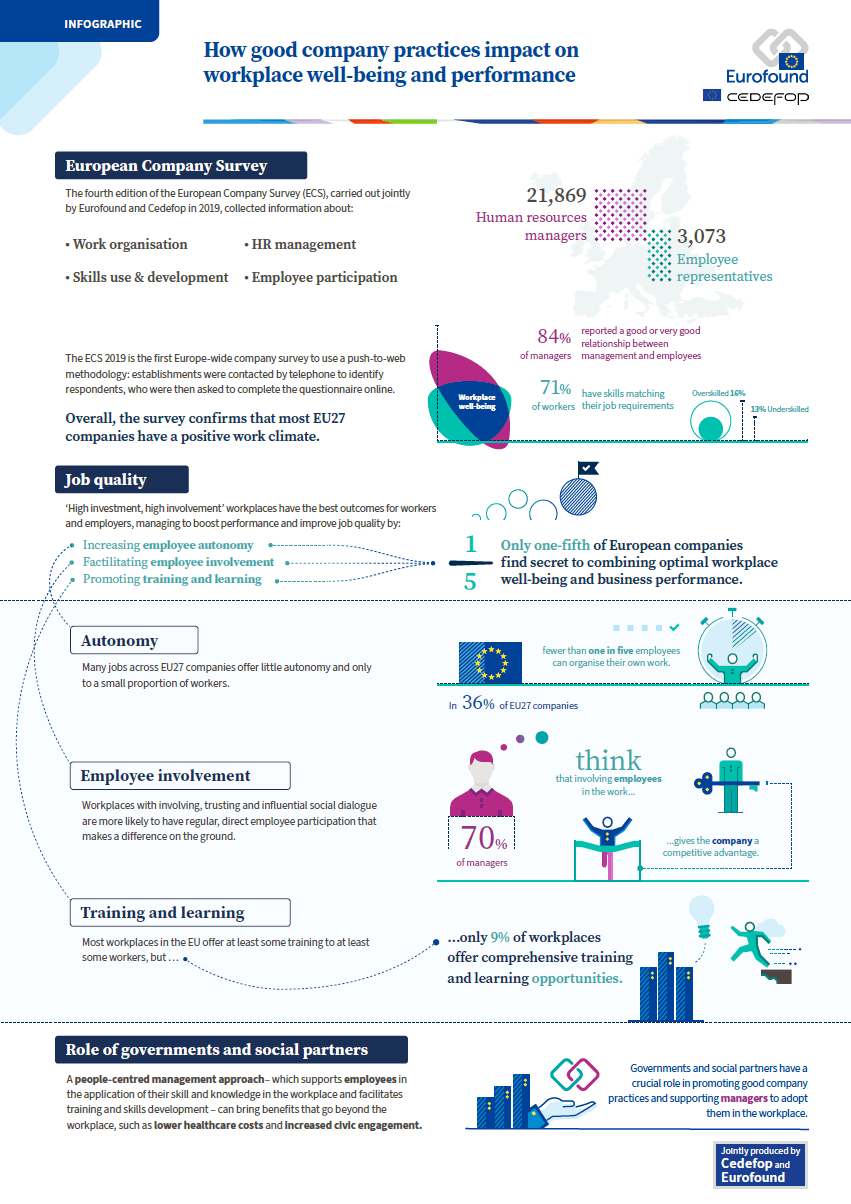
Climate change is a reality in our everyday lives in Europe. Workers experience the effects of climate change and climate change policy in many ways, both directly and indirectly, from working in heat and experiencing greater exposure to UV radiation, to new occupational safety and health risks and the need for training and re-skilling.In this episode of Eurofound Talks Mary McCaughey speaks with Eurofound researchers Agnès Parent-Thirion, Tina Weber and Jorge Cabrita about the extent to which climate change is already influencing working conditions and the labour market in Europe, the role of the green transition, and how policy can help protect workers and safeguard workplaces.Eurofound aims to consolidate the position of its European Working Conditions Survey (EWCS) as an important tool for benchmarking job quality in the European Union and beyond, feeding into policy development in the area of quality of work. The data have been used to carry out further research on various topics linked to job quality, including job quality in different work situations, job quality of different groups in the labour market, the impact of job quality on quality of working lives and in-depth analysis of individual dimensions of job quality. The European Company Surveys (ECS) also looks at different dimensions of job quality for workers and employers. Recent research has also looked into job quality in a global perspective.
Job quality and its improvement is an important policy concern, as quality jobs are crucial for higher labour force participation, higher well-being and increased economic performance. Job quality is also a key component in making work sustainable and enabling workers to remain motivated to remain in work for longer. It is central to the ILO’s Decent Work Agenda, the OECD’s jobs strategy and to the European Union’s quality of work policies to create more and better jobs. For workers, for the enterprises and organisations that employ them and for societies, there are benefits associated with high-quality jobs, and costs associated with poor-quality jobs.
On 4 December 2025, the European Commission published its Quality Jobs Roadmap which aims to ensure fair wages, good working conditions, future-oriented education and skills, and fair labour mobility for workers and self-employed people. This initiative supports the drive to strengthen the EU’s competitiveness as outlined in the Competitiveness Compass and to create and maintain quality jobs across the Union. At the same time, the Commission expects to publish the proposal for a Quality Jobs Act by the end of 2026.
European Commission: Commission sets out roadmap for future-proof quality jobs in a competitive EUopens in new tab
Commission priority: Supporting people, strengthening our societies and our social modelopens in new tab
International Labour Organization (ILO): Decent work and the 2030 Agenda for sustainable developmentopens in new tab
Organisation for Economic Co-operation and Development (OECD): OECD Jobs Strategyopens in new tab
European Commission: European employment policiesopens in new tab
Researchers at Eurofound provide expert insights and can be contacted for questions or media requests.
Agnès Parent-Thirion
Senior research managerAgnès Parent-Thirion is a senior research manager in the Working Life unit at Eurofound, overseeing the planning and development of working conditions research. She plays a key role in the European Working Conditions Survey (EWCS), co-leading the preparation of and leading the questionnaire development for EWCS 2030. Her research interests include job quality, work organisation, gender, psychosocial risks and the impact of the green and digital transitions on working life. With over two decades of experience working on European comparative surveys, Agnès specialises in questionnaire development, coding of occupations, quality control and analysis. She is a graduate in economics and management from Paris IX Dauphine and Paris I Panthéon Sorbonne universities and holds a Postgraduate Diploma in Statistics from Trinity College Dublin. She has also completed specialised training on AI leadership (MIT Sloan Executive Education) and the major challenges of transition (Campus de la Transition). Before joining Eurofound, she worked for a number of years in the European Commission.
Jorge Cabrita
Senior research managerJorge Cabrita is a senior research manager in the Working Life unit, where he designs, coordinates, and manages Europe-wide research and disseminates its findings. His main areas of expertise include working conditions and job quality, working time and work–life balance, workers’ health and well-being, gender equality, and the socioeconomic impacts of the green transition. He currently leads research on working time developments and job quality in climate-vulnerable regions, and co-leads the implementation of the European Working Conditions Survey 2030. Previously, he was a researcher at the Centre for Studies for Social Intervention and the Research Centre on the Portuguese Economy, and worked as a trainer and consultant. He holds a BSc in Economics and an MSc in Socio-Organisational Systems of Economic Activity from the Lisbon School of Economics.
This section provides access to all content that has been published on the topic.